publications, Réseau
Hybrid molecular graphene transistor as an operando and optoelectronic platform.
Lack of reproducibility hampers molecular devices integration into large-scale circuits. Thus, incorporating operando characterization can facilitate the understanding of multiple features producing disparities in different devices. In this work, we report the realization of hybrid molecular graphene field effect transistors (m-GFETs) based on 11-(Ferrocenyl)undecanethiol (FcC11SH) micro self-assembled monolayers (μSAMs) and high-quality graphene (Gr) in a… Read More
publications, Réseau
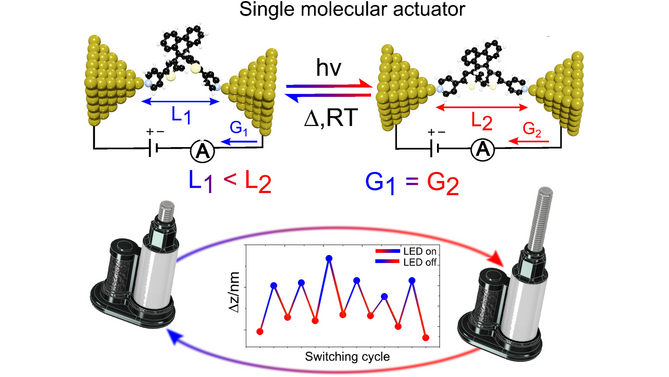
Dithienylethene-Based Single Molecular Photothermal Linear Actuator
By employing a mechanically controllable break junction technique, we have realized an ideal single molecular linear actuator based on dithienylethene (DTE) based molecular architecture, which undergoes reversible photothermal isomerization when subjected to UV irradiation under ambient conditions. As a result, open form (compressed, UV OFF) and closed form (elongated, UV ON) of dithienylethene-based molecular junctions… Read More

publications, Réseau
Visualizing In-Plane Junctions in Nitrogen-Doped Graphene
Controlling the spatial distribution of dopants in graphene is the gateway to the realization of graphene-based electronic components. Here, it is shown that a submonolayer of self-assembled physisorbed molecules can be used as a resist during a post-synthesis nitrogen doping process to realize a nanopatterning of nitrogen dopants in graphene. The resulting formation of domains… Read More
publications, Réseau
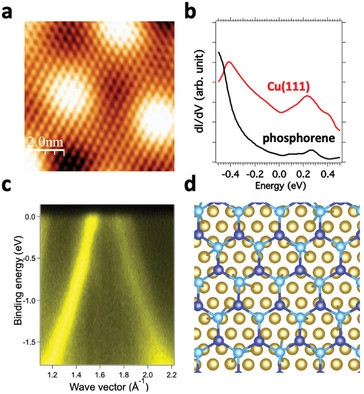
Dirac Fermions in Blue Phosphorene Monolayer
2D materials beyond graphene and in particular 2D semiconductors have raised interest due to their unprecedented electronic properties, such as high carrier mobility or tunable bandgap. Blue phosphorene is an allotrope of black phosphorene that resembles graphene as it presents a honeycomb structure. However, it is known to have semiconductor character and the crucial point is… Read More

publications, Réseau
Structural and electronic properties of Bi/Au(110)
Atomically thin bismuth films (2D Bi) are becoming a promising research area due to their unique properties and their wide variety of applications such as spintronics, electronic and optoelectronic devices. We report on the structural and electronic properties of Bi on Au(110), explored by low-energy electron diffraction (LEED), scanning tunneling microscopy (STM) and density functional… Read More

publications, Réseau
Quantum Advantage in a Molecular Spintronic Engine that Harvests Thermal Fluctuation Energy
Recent theory and experiments have showcased how to harness quantum mechanics to assemble heat/information engines with efficiencies that surpass the classical Carnot limit. So far, this has required atomic engines that are driven by cumbersome external electromagnetic sources. Here, using molecular spintronics, an implementation that is both electronic and autonomous is proposed. The spintronic quantum… Read More

Actu, publications, Réseau
Newsletter #1
Première édition de la newsletter du GDR NEMO lien Read More

publications, Réseau
Planar bridging an atomically precise surface trench with a single molecular wire on an Au(1 1 1) surface
In a bridge configuration, a single graphene nanoribbon (GNR) is positioned with a picometer precision over a trench in between two monoatomic steps on an Au(1 1 1) surface. This GNR molecular wire adopts a deformed conformation towards the down terrace in between the two contact step edges. Using differential conductance dI/dV mapping from a… Read More
publications, Réseau
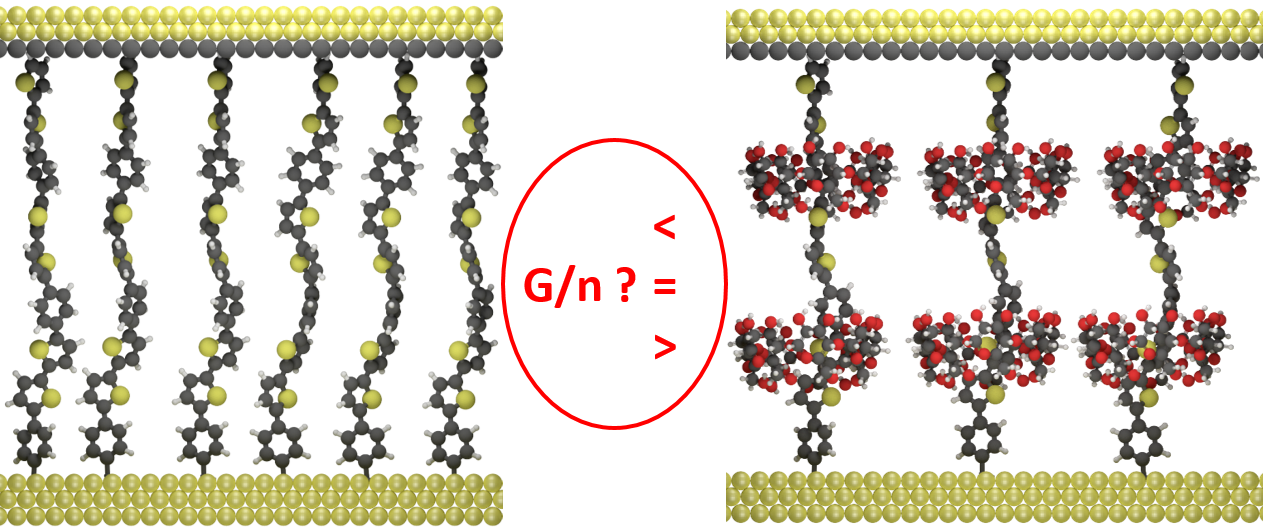
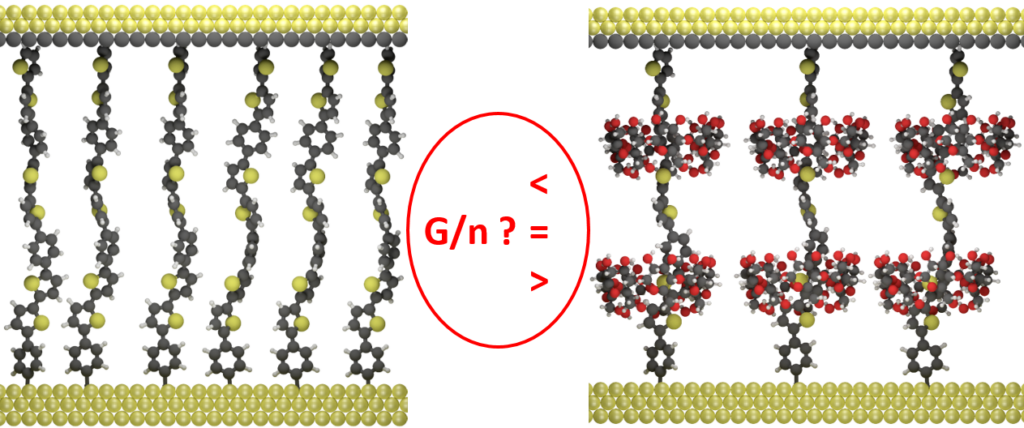
Probing the Effect of the Density of Active Molecules in Large-Area Molecular Junctions
The effect of the density of active molecules in molecular junctions (MJs) has been investigated by using a host/guest strategy. Mixed layers consisting of oligothiophene (BTB) encapsulated by β-cyclodextrin (BTB@β-CD) were generated. Cyclodextrins were then removed, and the pinholes generated were filled with BTB to obtain BTB@BTB films. MJs based on mixed BTB@β-CD and BTB@BTB layers, as well as single-component… Read More
publications, Réseau
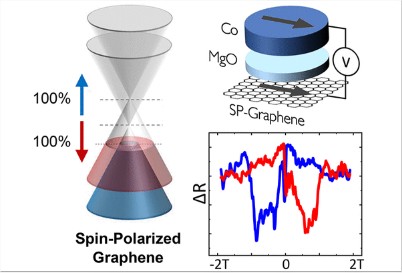
Artificial Graphene Spin Polarized Electrode for Magnetic Tunnel Junctions
2D materials offer the ability to expose their electronic structure to manipulations by a proximity effect. This could be harnessed to craft properties of 2D interfaces and van der Waals heterostructures in devices and quantum materials. We explore the possibility to create an artificial spin polarized electrode from graphene through proximity interaction with a ferromagnetic… Read More